
EMERGENCY STORM RESPONSE

Mobile Home Storm Damage Repair in Show Low, AZ

Show Low sits at 6,300 feet in the White Mountains. This elevation puts it in the path of some of the most severe weather in Arizona. Summer monsoon storms bring hail, 60-plus mile per hour winds, and lightning strikes between July and September. Winter storms bring heavy wet snow, ice, and blizzard conditions that can arrive overnight without warning. When a storm damages your manufactured home, response time matters. A roof panel that peels back in a windstorm lets water into the ceiling cavity within hours. A broken window or damaged skirting during a winter storm can freeze your water lines overnight. Fast, licensed repair work stops a bad situation from turning into a much larger loss. Show Low Mobile Home Contractors responds to storm damage calls across Navajo County. We assess the damage, tarp and secure the home to stop further loss, document everything for your insurance claim, and complete the permanent repair. All work is performed by ADOH-licensed contractors.
OUR STORM SERVICES

Mobile Home Storm Damage Services We Provide

Every service below is available as part of an emergency response or as a scheduled repair after the immediate situation is stabilized. All work is ADOH-licensed and Navajo County permitted.

Storm Damage Inspection and Assessment — Show Low, AZ
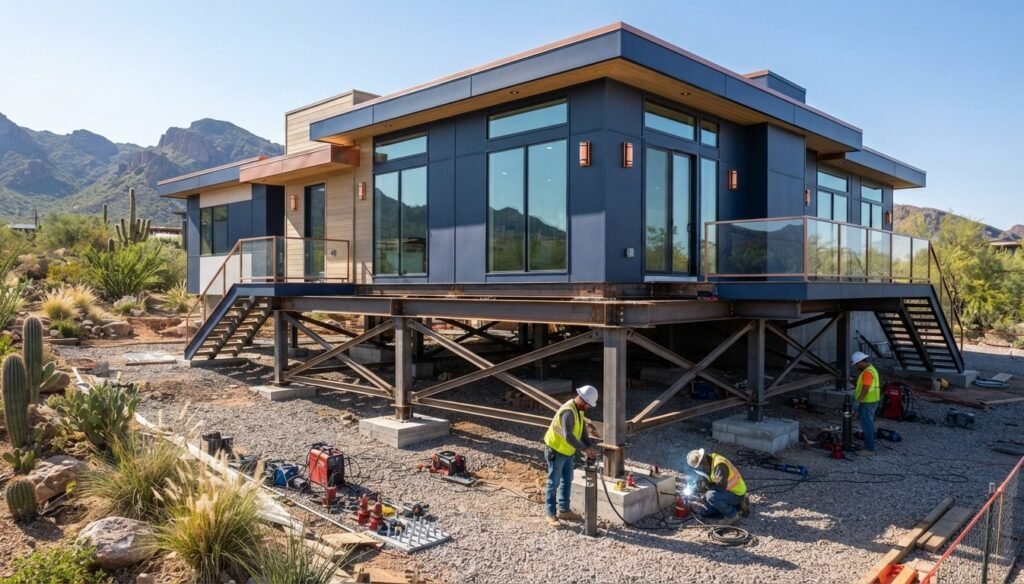
A full storm damage assessment is the foundation of every repair and every insurance claim. You cannot scope a repair or document a claim without knowing every damage point. Ground-level inspection misses damage on roofs and in the belly area below the home. We assess from every angle before writing the damage report. We conduct aerial roof inspections at every job using a DJI Mini 4 Pro drone with 48MP camera and omnidirectional obstacle sensing, which lets the operator fly close to the roof surface and document damage at panel joints, eave edges, ridge caps, and penetrations from above without the crew setting foot on a damaged, potentially unstable roof structure during the initial assessment phase. Storm damage inspection and reporting on manufactured homes follows Navajo County Building and Safety post-storm structural assessment protocol and ADOH notification requirements under the manufactured home installation permit process, which establish when a structural inspection report must be filed before repair work begins on a permitted manufactured home installation.

Emergency Roof Tarping and Temporary Repair — Show Low, AZ

An open roof after a storm event is a time-critical problem. In Show Low, a roof breach during monsoon season means the next afternoon thunderstorm delivers rain directly into the ceiling cavity. A roof breach in winter means snow enters and melts against the ceiling insulation and framing, causing secondary water damage that is far more expensive than the original storm repair. We deploy emergency tarping as soon as it is safe to access the roof. All crew members working on damaged roof surfaces during emergency tarping operations wear full fall protection rated for their body weight and tool load. Fall protection harness and lanyard for each crew member is the FallTech 7663 hinged D-ring roofer’s harness with a shock-absorbing 6-foot lanyard rated to 310 lbs and anchored to a permanent ridge anchor installed at the peak before any crew member steps onto the roof surface, which keeps every crew member connected to the roof structure at all times during emergency tarping work on damaged roof panels that may have reduced load capacity at the failure zone. Emergency roofing work follows OSHA 29 CFR 1926.502 fall protection requirements for roofing operations, which require a fall arrest system for all workers on roofs with an unprotected edge or side more than 6 feet above a lower level, regardless of the duration of the task.

Wind Damage Siding and Panel Repair — Show Low, AZ

Wind events that exceed 60 miles per hour blow siding panels off manufactured home wall sections where the fastening failed or the panel was already compromised. Once panels are off, the housewrap and sheathing behind them are exposed to rain and further wind loading. The longer they stay exposed, the more secondary damage accumulates. We replace wind-damaged siding panels using material matched to the existing profile and color where possible. Before replacement panels are fastened, we locate the wall studs behind the sheathing at each panel section using a Zircon StudSensor e50 deep-scanning stud finder calibrated for manufactured home 16-inch on-center framing, which detects the edge and center of each stud through the OSB sheathing behind the damaged section and marks the fastener line so replacement panels are secured directly into framing rather than into the sheathing alone. Wind damage siding repair on manufactured homes follows HUD 24 CFR 3280.306 exterior covering wind resistance requirements, which define the minimum fastener size, spacing, and penetration depth for siding panels on manufactured home exterior wall assemblies subject to the design wind speed for the site.

Hail Damage Roof and Siding Restoration — Show Low, AZ

Hail damage is more than cosmetic. On metal roofing panels, each hail dent breaks the factory baked-enamel coating at the center of the impact. Over the following months, moisture sits in the concave dent and oxidizes the bare metal at the coating break. Within one to three seasons, these impact points develop pinhole corrosion leaks. On vinyl siding, hail impact cracks allow water behind the panel face immediately. We measure hail impact dent depth on aluminum and steel roofing panels using a Mitutoyo 547-301 Absolute Digimatic 6-inch depth gauge with a 0.001mm resolution carbide blade, which records the exact depth of each dent below the undamaged panel surface. These measurements are recorded in the damage documentation log and submitted to the insurance adjuster to establish that impacts exceed the threshold for coating failure and qualify for panel replacement rather than patch coating. Hail damage assessment and roofing restoration follows FM 4473 impact resistance classification standard published by the Insurance Institute for Business and Home Safety (IBHS), which provides the industry benchmark for classifying hail impact severity on roofing products and supports insurance adjuster determinations for replacement versus repair qualification.

Tree Impact and Structural Damage Repair — Show Low, AZ

A tree fall on a manufactured home is a high-urgency event. The tree has to be removed before the structural damage below it can be assessed. While the tree is still in contact with the roof, the weight load is variable and conditions on the roof are unsafe. We coordinate with a licensed tree removal service and assess the structural damage below after the tree is fully removed from the home. Before any structural repair begins, the fallen tree and the damage zone dimensions are measured so the repair scope can be fully documented for the insurance claim. We measure the diameter, length, and weight distribution of the downed tree and the extent of the impact zone using a Nikon Forestry Pro II laser rangefinder with Hypsometer mode, which measures the tree’s length and crown spread from a safe standoff distance and records the measurements to a digital log without requiring the crew to enter the impact zone while the tree is still partially in contact with the roof structure. Tree impact structural repair on manufactured homes follows Arizona Registrar of Contractors licensing standards under A.R.S. Section 32-1121, which require that all structural repair work on manufactured home exterior and framing systems be performed by a contractor licensed for manufactured housing structural alterations.

Flood and Water Intrusion Remediation — Show Low, AZ

Water intrusion from a storm event causes two types of damage. The first is the immediate physical damage from standing water in rooms, saturated flooring, and wet wall cavities. The second is microbial growth, which starts within 24 to 72 hours in saturated material that is not dried and treated. Both types need to be addressed before any surface repair or rebuild begins. We remove standing water, extract moisture from saturated materials, and begin structural drying immediately after the intrusion source is sealed. Structural drying of the floor cavity, wall cavities, and ceiling assembly is accomplished using Dri-Eaz F284 LGR 2800i low-grain refrigerant commercial dehumidifiers with integrated digital humidistat control, which pull moisture from the air inside the affected space and maintain the dew point below the threshold for secondary mold germination until the moisture content in structural materials reaches the dry standard before any wall or floor rebuild begins. Water intrusion remediation work follows IICRC S500 Standard and Reference Guide for Professional Water Damage Restoration, which defines the water damage category classifications, drying protocols, moisture content dry standards by material type, and microbial contamination assessment requirements for residential water damage remediation projects.

Insurance Claim Documentation and Support — Show Low, AZ

A storm damage insurance claim lives or dies on the quality of the documentation. An adjuster reviewing a claim with complete measurements, photos from every angle including the roof surface, a written damage scope, and a licensed contractor’s repair estimate has everything needed to process the claim. A claim with a few ground-level phone photos and a verbal description of the problem often results in a lower settlement or a dispute over what the storm actually damaged. We create a complete damage documentation package for every storm-damage job we respond to. The interior and exterior damage zones are captured as a dimensionally accurate 3D model using a Matterport Pro2 3D scanning camera with 134-megapixel photography and millimeter-accurate spatial data, which allows the insurance adjuster to conduct a virtual walkthrough of the damage from their office and measure any dimension they need from the 3D model without requiring a second on-site visit to confirm the scope. Insurance claim documentation on manufactured home storm damage is governed by Arizona Department of Insurance property damage claim handling requirements under A.R.S. Section 20-1115, which specify the standards for timely and fair claims investigation and the documentation that a policyholder may submit to support the claimed loss.

Post-Storm Tie-Down and Anchor Inspection — Show Low, AZ

A storm event that moves a manufactured home off its piers or loads the tie-down anchors beyond their design capacity can compromise the anchoring system without any visible surface evidence. An anchor strap that looks fine from the outside may have elongated at the coupler, or a ground anchor may have rotated under the soil due to excessive uplift force during the storm. These failures leave the home under-anchored for the next storm event. We inspect every tie-down strap, coupler, and ground anchor after any storm where sustained winds exceeded 60 miles per hour or where visible movement of the home was reported. Anchor bolt torque values at the strap-to-anchor connection are checked using a Norbar 13035 professional 1/2-inch drive torque wrench with a calibrated scale accuracy of plus or minus 4 percent, which confirms that each anchor bolt is still at the specified torque value for the anchor size and soil class. A bolt that requires significantly less torque than specified indicates the anchor has moved or the thread engagement has loosened. Post-storm tie-down and anchor inspection follows HUD 24 CFR 3285 Subpart E anchoring system inspection standards, which establish the performance requirements for manufactured home anchoring systems after severe weather events and define the conditions under which a full re-anchoring to the installation permit specifications is required.
OUR RESPONSE PROCESS

How We Respond to Storm Damage Calls

Speed and documentation are the two things that matter most in the first 24 hours after a storm event.

Step 1: Emergency Contact and Dispatch

Call us as soon as you see damage. We dispatch an assessment crew to your property as quickly as conditions allow. If the storm is still active, we stage until it is safe to work on your roof or exterior.

Step 2: Aerial and Ground Assessment

We assess the damage from the roof, the exterior walls, and the underside of the home. We document every damage point with photos, measurements, and a written damage log before any temporary repair begins.

Step 3: Emergency Tarping and Securing

We tarp and seal any active weather-intrusion points. This stops additional water from entering the home while the permanent repair is scoped and permitted.

Step 4: Insurance Claim Support

We provide a complete documentation package to support your insurance claim, including photos, measurements, and a written repair scope. We communicate directly with your adjuster if needed to clarify the damage scope.

Step 5: Permitted Permanent Repair

We complete permanent repairs under permit from Navajo County Building and Safety. All structural repairs to the home follow HUD and ADOH standards for manufactured home alterations.
WE SERVE SHOW LOW & white mountains

We Serve Show Low and the White Mountains Region

Our storm damage crew covers Navajo County and Apache County. We are familiar with the soil conditions and wind exposure patterns across every community in the White Mountains area.
Not sure if we cover your location? Call us. We serve all of Navajo County and most of Apache County for storm damage work.

Why Show Low Homeowners Choose Us for Mobile Home Storm Damage Repair

We Respond Fast

Open weather intrusion points cause secondary damage with every hour they stay open. We dispatch assessment crews as quickly as conditions allow. We tarp and secure first, then we scope the full repair.

We Document for Insurance

We build the claim package while we assess the damage, not after. Photos from the roof surface, dimensions, written scope, and a licensed contractor estimate go to your adjuster as a complete package.

We Work to ADOH and HUD Standards

All structural repairs to manufactured homes must follow HUD construction standards and ADOH alteration licensing requirements. Our crew is ADOH-licensed for manufactured home structural work. The insurance company and the county inspector will both confirm this before accepting the repair.

We Inspect the Full Home, Not Just the Obvious Damage

A storm that damages the roof often also loads the anchoring system, displaces skirting, and opens penetrations in the belly board. We inspect all of these systems, not just the point of impact, so secondary damage is caught before it develops further.

Get Emergency Storm Damage Response for Your Mobile Home in Show Low, AZ

Did a storm damage your manufactured home? Do not wait. Every hour an intrusion point stays open adds to the cost of the repair. Show Low Mobile Home Contractors serves Show Low, Pinetop-Lakeside, Snowflake, and all of Navajo County.
🕐 Mon to Sat: 7:00 AM to 6:00 PM | Emergency Response Available
FAQ

Frequently Asked Questions

First, make sure the home is safe to enter. If you see structural collapse, smell gas, or see sparking electrical equipment, stay outside and call the gas company and electric utility before entering. Once it is safe, document the damage with your phone camera from inside and outside. Then call us. We assess the damage, tarp and secure any open intrusion points, and start the insurance documentation process. Do not wait for the insurance adjuster to schedule a visit before making emergency repairs. Temporary repairs to prevent further damage are almost always covered.

Structural repairs that involve replacing framing members, opening wall or roof assemblies, or modifying the home’s anchoring system require a permit from Navajo County Building and Safety. Emergency tarping and temporary stabilization do not. We confirm which repairs require a permit before any permanent work begins and file the permit before starting. Call Navajo County at (928) 532-6040 for questions about a specific repair.

Most homeowner’s and manufactured home insurance policies cover sudden storm damage from wind, hail, lightning, tree impact, and flood depending on your policy’s specific coverage. We provide a complete documentation package including contractor photos, damage measurements, and a written repair estimate to support your claim. We communicate with your adjuster directly if there are questions about the repair scope. What your policy covers ultimately depends on the policy terms and your deductible.

We dispatch assessment crews the same day during and immediately after a storm event whenever conditions allow safe travel. Emergency tarping crews are typically on site within 24 hours of a storm event for sites within Navajo County. Response to more remote Apache County sites may take an additional day. Call us as soon as you see damage so we can get you on the dispatch list.

Yes. Hail damage on manufactured home metal roofing is often not obvious from the ground. The dent pattern is subtle, and the real damage is the coating failure at each impact point that leads to corrosion over the following months. We inspect hail-damaged roofs at close range from the drone and on foot and measure dent depths with a calibrated gauge. If the damage qualifies for a claim, we build that documentation package for your adjuster.

A manufactured home with compromised tie-down anchors is more vulnerable to the next storm event. We inspect every anchor and strap after a significant wind event and document any that are out of specification. Anchors that have pulled, rotated, or elongated are replaced to the original installation permit specifications. We do not leave the job until the anchoring system is back to its full designed capacity.

Scroll to Top